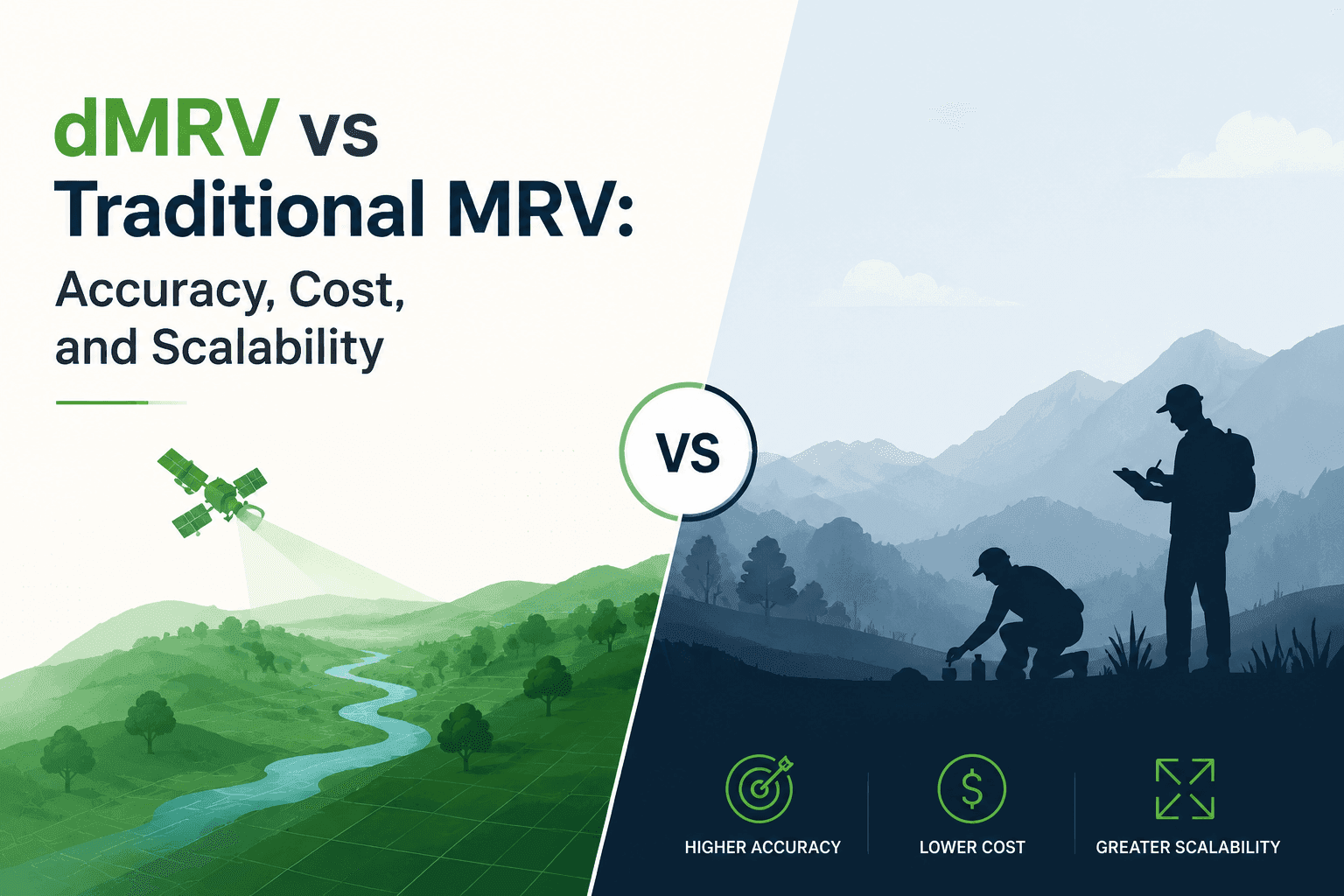
dMRV vs Traditional MRV: Accuracy, Cost, and Scalability
The Measurement Problem No One Talks About
In climate and nature projects, measurement is everything. Whether it is carbon credits, biodiversity restoration, or ecosystem impact, the credibility of outcomes depends entirely on how well they are measured.
Yet, most systems in place today are still built on manual, periodic, and fragmented processes. Data is collected infrequently, verification is delayed, and reporting often relies on assumptions rather than continuous evidence.
This is the fundamental limitation of traditional Measurement, Reporting, and Verification (MRV). While it has enabled the growth of environmental markets, it is increasingly struggling to keep up with the scale, complexity, and expectations of modern sustainability frameworks.
This is where digital MRV, or dMRV, is beginning to redefine the landscape.
What is Traditional MRV?
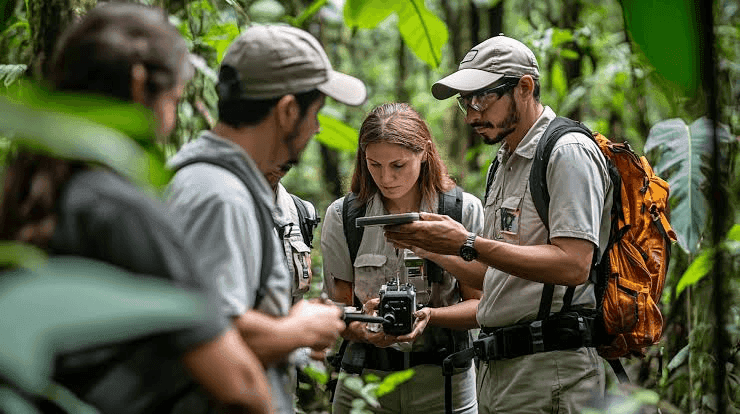
Traditional MRV relies on field surveys, manual data collection, project documentation, and third-party audits. It is commonly used in carbon projects, restoration programs, and sustainability reporting systems.
Its strength lies in credibility. Traditional MRV is useful for establishing baselines, validating methodologies, and providing independent verification. Standards such as Verra’s Verified Carbon Standard and Gold Standard for the Global Goals continue to depend on strong verification processes to maintain trust in environmental claims.
The limitation is that traditional MRV is often periodic. Data may be collected once every few months or once a year. By the time it is reported and verified, site conditions may have already changed. This creates a gap between what is happening on the ground and what appears in the report.
What is dMRV?
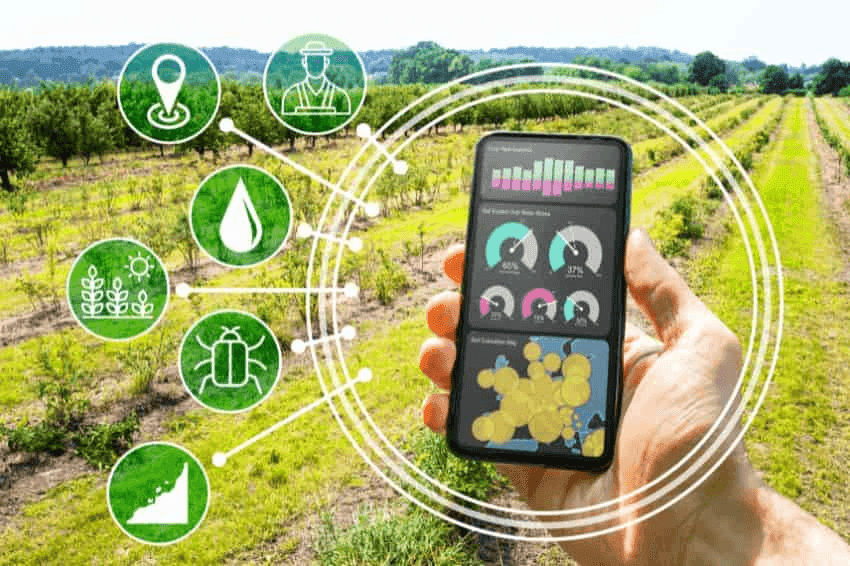
Digital MRV is more than the digitisation of traditional reporting processes. It represents a shift from periodic environmental assessment to continuous, data-driven monitoring that provides a more complete view of environmental performance over time.
Unlike traditional MRV systems that rely primarily on scheduled surveys and reporting cycles, dMRV combines multiple data streams—including satellite imagery, IoT sensors, bioacoustics, artificial intelligence, and geospatial analytics—to monitor environmental conditions continuously and at scale.
This approach is particularly valuable in environments where conditions change rapidly. Vegetation health may fluctuate following drought events, land-use patterns can shift around project boundaries, and biodiversity activity often varies seasonally. By capturing these changes through continuous monitoring, dMRV provides a stronger evidence base for environmental reporting, verification, and decision-making.
The objective is not to replace verification processes, but to strengthen them through more frequent, traceable, and evidence-based environmental intelligence.
The Core Differences:
Traditional MRV and dMRV differ across several important dimensions, including accuracy, cost, scalability, monitoring frequency, and transparency.
Accuracy:
Traditional MRV relies heavily on field observations, sampling, and periodic assessments. While these approaches provide valuable insights, uncertainty can increase as projects expand across larger geographies. dMRV improves accuracy by combining multiple data sources such as satellite imagery, sensors, bioacoustics, and geospatial analytics, creating a more comprehensive and continuous evidence base.
Cost:
Traditional MRV often requires repeated field visits, manual documentation, and extensive audit preparation, resulting in higher recurring costs over time. dMRV reduces much of this operational burden by automating data collection, analysis, and reporting processes, making long-term monitoring more cost-efficient.
Scalability:
Scaling traditional MRV across multiple sites or regions can become complex and resource-intensive because each location typically requires manual coordination and assessment. dMRV enables organisations to monitor large portfolios, landscapes, and distributed projects through a common digital framework, making expansion significantly more manageable.
Monitoring Frequency:
Traditional MRV generally operates on fixed monitoring intervals, with assessments conducted monthly, quarterly, or annually. dMRV supports continuous or near real-time monitoring, allowing organisations to track environmental changes as they occur rather than waiting for the next reporting cycle.
Transparency:
Traditional MRV depends largely on reports, documentation, and periodic third-party audits. dMRV strengthens transparency by creating traceable digital records, time-series datasets, and continuously updated evidence streams that improve verification and audit readiness.
This comparison does not suggest that traditional MRV has become obsolete. In practice, the strongest systems often combine the methodological rigour of traditional MRV with the continuous monitoring capabilities of dMRV.
dMRV and MRV Hybrid Systems
In practice, the future of environmental monitoring is unlikely to be a choice between traditional MRV and dMRV. A more effective approach is often a hybrid system that combines the strengths of both.
Traditional MRV provides methodological rigour, baseline establishment, field validation, and independent verification. dMRV contributes continuous monitoring, time-series analysis, and broader spatial coverage. Together, these approaches improve both scientific credibility and operational scalability.
For example, field teams may establish baseline ecological conditions and validate species observations, while satellite imagery tracks vegetation dynamics across the project area over time. Bioacoustic monitoring can provide continuous insights into biodiversity activity, with periodic field assessments used to verify ecological observations.
By combining continuous monitoring with field-based verification, hybrid systems reduce uncertainty, improve audit readiness, and strengthen confidence in reported outcomes. This is particularly important for carbon, restoration, and biodiversity projects where both accuracy and scalability are critical.
Accuracy: From Estimates to Evidence
Accuracy is one of the strongest advantages of dMRV. Traditional MRV often relies on sampling approaches where observations from selected locations are extrapolated across larger project areas. While this can be effective for smaller sites, uncertainty increases as projects expand across broader geographies.
dMRV improves accuracy by integrating multiple sources of environmental evidence. Satellite imagery can monitor vegetation change and land-use dynamics across entire landscapes, sensors can track environmental conditions such as temperature and soil moisture, and bioacoustic systems can capture biodiversity activity that may not be detected through periodic field visits.
For example, field assessments within a restoration project may indicate healthy vegetation conditions in selected sampling plots. However, satellite-based time-series analysis may reveal that vegetation is improving in one area while declining elsewhere. This broader perspective helps organisations identify emerging issues earlier, respond more effectively, and avoid conclusions based solely on limited samples.
Cost: From Operational Burden to Efficiency
Traditional MRV is operationally intensive. Field surveys, travel, documentation, and third-party audits all contribute to high recurring costs. These costs often limit the frequency of monitoring, which in turn affects data quality.
With dMRV, much of this process is automated. Data collection happens remotely or through embedded systems, reducing the need for repeated field interventions. Analysis is conducted using digital platforms, and reporting can be generated in near real time.
Over time, this leads to significant cost efficiencies, particularly for large-scale or long-term projects.
Scalability: From Pilot Projects to Landscape-Level Impact
Scalability is where dMRV becomes especially important. Many environmental initiatives begin as pilot projects but struggle to expand because monitoring becomes too complex.
Traditional MRV is difficult to scale across dispersed geographies because each site requires manual coordination. dMRV enables multi-site and portfolio-level monitoring, allowing data from different regions to be aggregated, compared, and analysed through a common framework.
This also improves cross-regional comparability. A company managing restoration, carbon, or biodiversity projects across different states or countries can track performance consistently instead of relying on fragmented local reports.
Role of Geospatial Intelligence in dMRV
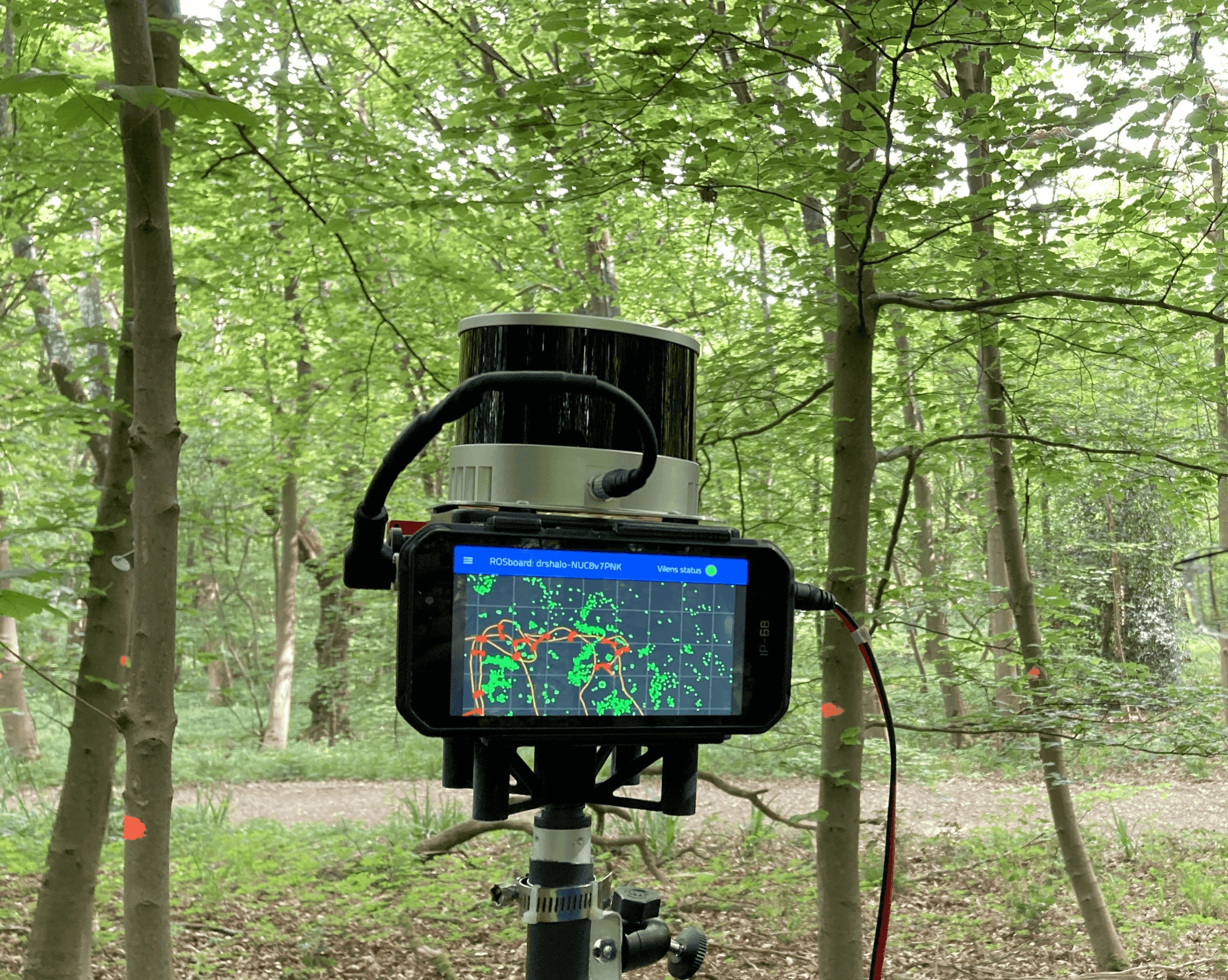
Geospatial intelligence is one of the most important components of modern dMRV systems because it connects environmental information to specific locations, assets, and landscapes.
Environmental performance is rarely uniform across a project area. Conditions can vary significantly due to terrain, water availability, climate exposure, land-use pressure, or surrounding ecosystem characteristics. Geospatial intelligence helps organisations understand these differences spatially rather than relying solely on aggregated project-level indicators.
Satellite observations can reveal where vegetation conditions are changing, where environmental pressures are increasing, and where project boundaries may be exposed to emerging risks. Spatial analysis also enables organisations to compare performance across sites, identify hotspots, and prioritise interventions where they are likely to create the greatest impact.
By linking environmental change to geographic context, geospatial intelligence helps organisations understand not only whether change is occurring, but also where it is occurring, why it matters, and how it may affect project outcomes.
The Darukaa Perspective: From Monitoring to Intelligence
At Darukaa, dMRV is more than a monitoring framework. It functions as a continuous environmental intelligence system that links environmental observations directly to operational and strategic decisions. The goal is not only to collect data, but to transform it into actionable insights that support risk management, resource allocation, and project prioritisation.
Darukaa integrates multiple environmental data streams into a unified analytical framework. Satellite analytics track vegetation condition, land-use change, and ecosystem transformation over time, providing a broad landscape view. Geospatial intelligence adds critical spatial resolution, delivering site-level context, asset-level mapping, and risk distribution analysis. Bioacoustic monitoring captures biodiversity activity through ecosystem soundscapes, while environmental sensors measure local conditions such as temperature, soil moisture, and water quality. Climate datasets and time-series analysis enable continuous monitoring, trend evolution, and detection of ecosystem change across seasons and years.
This integration produces a continuously updated view of ecosystem health, biodiversity trends, climate exposure, and overall environmental performance. It strengthens MRV processes by improving traceability, enabling audit-ready verification, and enhancing reporting credibility.
Beyond monitoring, the system provides operational value. Organisations can prioritise risks, allocate capital efficiently, enhance asset resilience, and maintain compliance readiness. Investors gain insight into portfolio-level exposure and ecosystem-related financial risk, while project teams can target interventions where measurable outcomes are most needed, ensuring that environmental actions are both effective and verifiable.
From Monitoring to Decision Systems
The greatest value of dMRV lies not in reporting itself, but in its ability to support better decisions. Environmental monitoring becomes more useful when collected data is translated into meaningful signals that help organisations understand risks, opportunities, and performance trends.
Continuous monitoring generates environmental observations that can be analysed to identify emerging patterns and areas of concern. These signals help reveal risks and opportunities, which in turn inform operational and strategic decisions. The outcomes of those decisions can then be monitored and evaluated, creating an ongoing feedback process that continuously improves future actions.
This approach transforms environmental measurement from a compliance exercise into a dynamic decision-support system. Organisations gain a clearer understanding of where projects are performing well, where risks are increasing, and where targeted interventions are required to improve outcomes.
Why dMRV is Becoming the New Standard
The transition to dMRV is being driven by increasing expectations from regulators, investors, and markets. Frameworks aligned with transparency and accountability are demanding more frequent, accurate, and verifiable data.
In India, evolving standards under frameworks like Business Responsibility and Sustainability Reporting (BRSR) are pushing organisations toward more robust reporting practices. Globally, carbon markets and nature-based solutions are also moving toward higher levels of scrutiny.
In this environment, traditional MRV is no longer sufficient. The need is for systems that can provide continuous, auditable, and scalable evidence.
Beyond Compliance: A Strategic Advantage
While dMRV is often seen as a compliance tool, its real value lies in its strategic potential. Organisations that adopt dMRV early gain access to high-quality data that can inform everything from project design to risk management.
This enables better decision-making, improved operational efficiency, and stronger credibility with stakeholders. It also creates opportunities to unlock new revenue streams, such as high-integrity carbon credits backed by verifiable data.
Ultimately, dMRV transforms measurement from a cost centre into a value driver.
The Future of Environmental Measurement
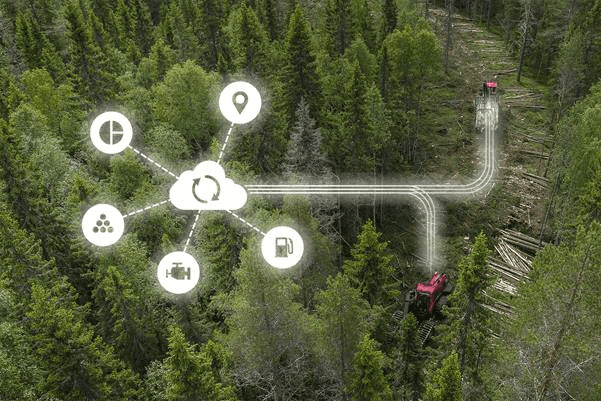
As sustainability initiatives move from commitment to implementation, the importance of accurate, transparent, and scalable measurement will continue to grow. The transition from traditional MRV to dMRV reflects a broader shift toward data-driven environmental management, where decisions are increasingly informed by continuous evidence rather than periodic assessments.
In this context, long-term success will depend not only on the number of projects implemented, but also on the quality, credibility, and measurability of the outcomes achieved. Strong environmental performance ultimately depends on strong measurement systems capable of supporting both accountability and informed decision-making.
FAQs
1. What is dMRV?
dMRV is a digital system that uses sensors, satellites, and analytics to monitor environmental data in real time.
2. How is dMRV different from MRV?
MRV is manual and periodic, while dMRV is automated, continuous, and data-driven.
3. Why is dMRV more accurate?
It uses real-time data from multiple sources, reducing reliance on estimates and sampling.
4. Is dMRV more cost-effective?
Yes, it lowers long-term costs by reducing fieldwork and manual reporting.
5. What technologies power dMRV?
Satellite imagery, IoT sensors, bioacoustics, AI, and geospatial analytics.
6. Can dMRV be used for carbon credits?
Yes, it improves transparency and credibility in carbon credit projects.
7. Why is MRV hard to scale?
Manual processes and site visits make large-scale monitoring complex and expensive.
8. How does dMRV improve transparency?
It provides continuous, verifiable data that reduces reporting gaps.
9. Is traditional MRV still used?
Yes, but it is increasingly being replaced or supported by dMRV systems.
10. How does Darukaa use dMRV?
Darukaa combines climate, biodiversity, and geospatial data into actionable insights.